

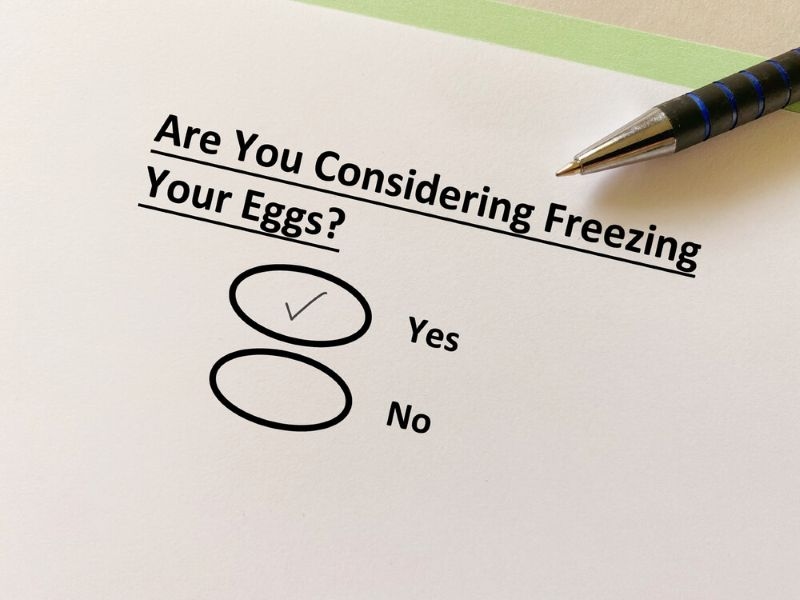
Egg freezing used to sound distant, almost experimental. Now it’s a practical choice many women think about early—sometimes too late, sometimes just in time. Careers stretch, relationships delay, biology doesn’t pause. That tension sits quietly until someone brings it up in a doctor’s room or a late-night Google search.
Decisions around fertility are rarely clean or logical. They’re layered—age, money, fear, timing, hope. Egg freezing steps in as a kind of pause button, not a guarantee, not a fix. Just an option. In this blog, we break it down in real terms, not ideal ones.
Egg freezing and fertility decisions sit close together. You don’t really think about one without the other. Egg freezing, medically called oocyte cryopreservation, is about storing unfertilized eggs for later use. Simple idea. Complicated reality.
You go through hormone injections. Eggs are retrieved. Then frozen at very low temperatures. That’s the technical part. But what matters is why people do it:
It’s not insurance. More like a backup file—you hope you won’t need it, but it’s there.
Hormones kick your ovaries into gear so they produce several eggs instead of the usual one. Then, a doctor collects the eggs during a simple procedure. After that, the eggs get frozen fast with a method called vitrification. They stay in storage until you’re ready.
When the time comes, the clinic thaws the eggs, fertilizes them, and transfers the embryo through IVF.
But here’s the catch—success depends heavily on age at freezing. Not when you use them. That detail gets missed often.
Cost is where things get real fast.
Egg freezing cost isn’t one number. It’s layers.
Typical Expenses:
In the United States, a single egg freezing cycle usually ranges from about $10,000 to $15,000. Medications can add another $3,000 to $6,000, and storage typically costs around $500 to $1,000 per year. Then later, IVF costs come in.
One cycle might not be enough. Some women need two or three to store a good number of eggs.
Fertility preservation is the bigger umbrella. Egg freezing is just one part.
It’s not only for women delaying motherhood. There are medical reasons too—serious ones.
And sometimes—no clear reason. Just a feeling.
Egg freezing stands out because it doesn’t require a partner. That independence matters.
But again—it preserves potential, not certainty.
The AMH test fertility conversation is often the starting point.
AMH stands for Anti-Müllerian Hormone. It gives an idea of ovarian reserve—how many eggs you may have left.
But it’s not a full fertility report.
It doesn’t tell:
Doctors use it as one piece of the puzzle, along with age, ultrasound, and medical history.
Still, AMH can push decisions forward. Someone with low levels at 30 might think differently from someone with average levels.
One number. Big impact.
Egg freezing is often linked with IVF. But they’re not the same thing.
IVF alternatives come into play when people want different paths—or less intervention.
Egg freezing sits somewhere in between. Not immediate treatment, not passive waiting.
It gives time. That’s its main role.
But if someone is actively trying to conceive, IVF or IUI might be more relevant.
Different tools. Different timing.
Fertility age and decline—this is the core truth behind all of it.
Women are born with a fixed number of eggs. Over time, both number and quality drop.
Slow at first. Then sharper.
This isn’t exact. But directionally true.
Egg quality matters more than quantity. Older eggs have a higher chance of chromosomal issues.
That’s why freezing at 28 is very different from freezing at 38.
Same process. Different outcomes.
Egg freezing is considered safe. Still, not risk-free.
Rare but possible:
Most recover quickly. Within days.
But it’s still a medical procedure. Not something to treat casually.
There’s no perfect time to freeze eggs.
But there’s a practical window.
Most experts suggest the late 20s to early 30s. Fertility is still relatively strong, yet decisions about family may not be settled.
So timing becomes a balance between biology and life reality.
And that balance looks different for everyone.
Egg freezing sits in a grey space—part science, part timing, part emotion. It doesn’t promise a child. It offers a chance, maybe a better one than waiting without a plan. That matters for many women, especially where life paths don’t match biological clocks.
Still, it’s not a default decision. Costs are real, outcomes uncertain, and the process demanding. Some benefit deeply, others feel it wasn’t needed. The only useful approach is informed choice—clear facts, honest expectations, no hype. In the end, egg freezing is less about control and more about keeping doors open. And sometimes, that’s enough.
Most women don’t describe it as painful, but more uncomfortable. Hormone injections can cause bloating or mood changes. The egg retrieval is done under sedation, so you won’t feel it during the procedure.
No, frozen eggs don’t “expire” if stored properly. They can remain viable for many years. But success depends more on the age when eggs were frozen, not how long they’ve been stored.
One thing to know— not all eggs survive thawing. Freezing tech has gotten better, but some eggs just don’t make it. That’s why doctors freeze more than one, to give you the best shot later.
No, it doesn’t reduce your natural fertility. The eggs retrieved are ones your body would have naturally lost that cycle. Ovulation continues as usual after the process.
This content was created by AI